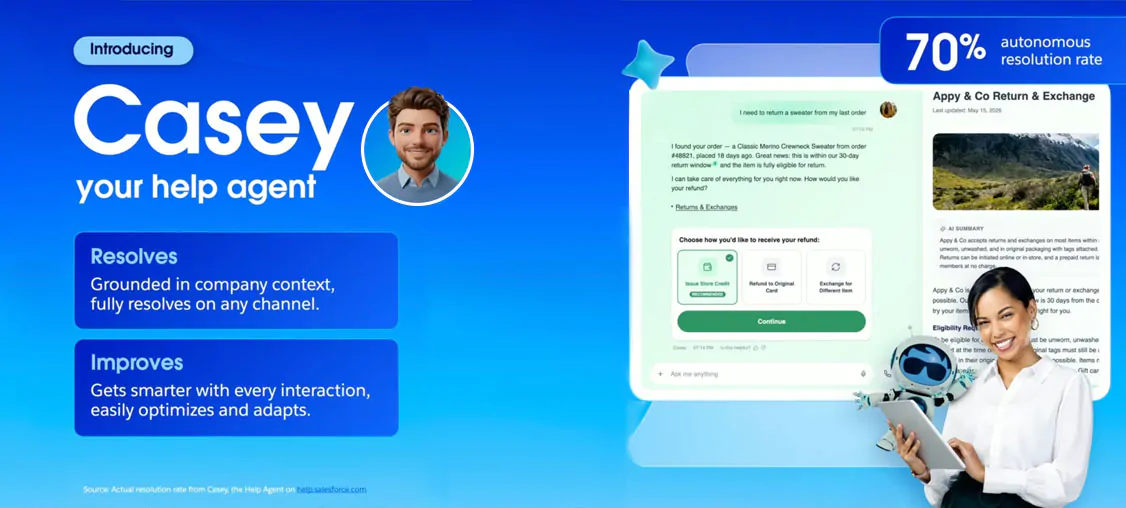
Ahead of Dreamforce, Salesforce introduced Casey, one of its 2 newest customer service AI agents.
But we've actually known him for a while. Back then he didn't have a name. Just a job: answering "Where's my order?" hundreds of times a day.
How Casey works
Casey isn't a blank AI you have to train from scratch. It's a ready-made agent with one job: solving customer problems from start to finish.
Here's what it can and can't do:
- It answers from your content. Casey works from your Salesforce help articles, plus any files or web pages you give it. So its answers come from your own policies and product details.
- It sees the same customer records your team does. Casey is connected to your customer data in Salesforce, so it knows who it's talking to. And it only sees what your permissions allow.
- It comes with the basics switched on. Out of the box, Casey answers common questions, handles returns and account changes, manages cases and hands over to a person.
- You can add more jobs when you're ready. Order tracking and appointment booking are ready to add. Anything specific to your business can be built on top.
- You set the rules it must always follow. For decisions that can't be left to judgement, like who qualifies for a refund, you set fixed rules. Casey can't step outside them.
- It goes live on every channel at once. Phone, web chat, your customer portal, SMS and WhatsApp, all set up from one screen. You can test its answers before a single customer sees them.
The limits? Casey only does the jobs you've switched on, using the content and records you've given it. Anything outside that goes to a person, with the full conversation attached.
What Casey takes off your service team’s plate
Picture your service inbox on a Monday morning.
Weekend orders asking where they are. Returns waiting for a reply. Customers who called, then emailed, then chatted about the same enquiry. Your team spends the morning catching up, instead of helping the customers who really need them.
That’s the work Casey is built to take on.
- Answers order questions any time, even 9pm on a Sunday. With order tracking added, Casey gives customers the real status straight away, without waiting for your team to log on.
- Handles returns, sorted in one conversation. No form to fill in, no "someone will call you back". Casey processes it then and there, within your rules.
- Updates customer details and books appointments. Routine admin gets done on the spot, without a ticket landing in your team’s queue.
- Keeps the story straight across channels. A customer can start on chat and switch to the phone. Casey knows who they are and what they’ve said, so you get fewer repeat contacts.
- Tells customers about delays before they chase. When an order runs late or an appointment changes, Casey lets the customer know first, before they call your team.
- Hands over to your team with the full story. When a customer needs a person, your team gets the whole conversation. Nobody starts from scratch.
The upside for your team? Fewer repeat questions, and more time for the ones that really need a person.
Salesforce runs Casey on its own help site. It reports he has handled more than 4 million enquiries there, resolving around 70% of them without a person stepping in.
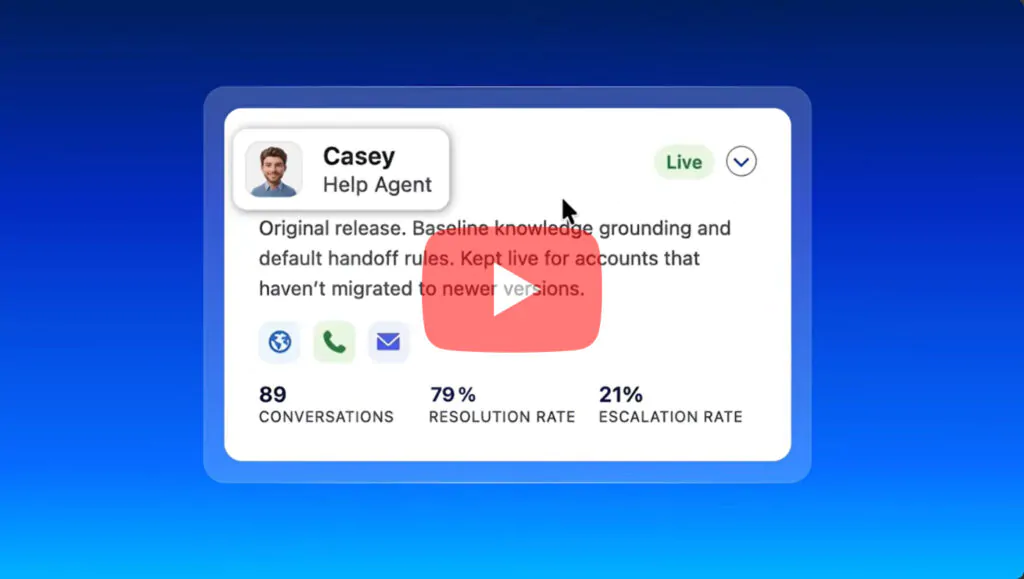
👉See it in action: How Casey the Help Agent Drives Higher Resolutions, ft. F1
Who Casey is for
Casey makes the most sense if your service team already runs on Salesforce. He lives where your help articles, cases and customer details already are. No new system to feed.
If your service team runs on a different help desk, Salesforce's other new agent, Fin, is built for that. We'll cover Fin next.
Before Casey: the service agents ProQuest built first
In late 2024, Salesforce launched Agentforce, its platform for building AI agents. At that time, most of our customers wanted the same thing: help with customer service.
So very quickly, our team was getting the first Agentforce service agents into production.
At Kudosity, we helped built "Emily". Live on the website from January 2025, answering FAQs, sharing help articles and raising tickets. She handled up to 40% of general support queries.
At Henry Schein Australia, the AI agent tracked orders, pulling live updates from the ERP. We built the proof of concept in 5 weeks. He now handles 70% of customer chats.
At Kogan, we built the AI agent that could connect to their order management system securely so it could give customers live order updates and process cancellations and returns on the spot. It went live in January 2025 after a 10-week build, handling 40% of customer enquiries. Since then, it has grown to automate more than half of Kogan's customer interactions.
Different names. Different data. The same job.
Salesforce clearly saw the same pattern we did. Businesses wanted an AI agent that knows the answers, gets simple things done, and knows when to call a person.
But there was a catch. Early agents ran on Flex Credits, so you paid for every action the agent took. That became a barrier for many businesses. They liked what the agent could do, but they couldn’t predict what it would cost. A busy month meant a bigger bill, whether customers’ problems got solved or not.
So Salesforce packaged that agent up. First as the help agent in July 2026. Then in September, it gave it a name. What used to take a custom build now comes ready out of the box. That’s Casey.
And the price finally matches the result. Casey is priced per resolution. You only pay when it fully solves a customer’s issue on its own. If the customer asks for a person, there’s no charge.
Getting started with Casey is easier than you think
Building Casey's ancestors taught us that the first step doesn't need to be big.
- Start with the questions your team answers every day. You don't need a big AI plan. Order status and simple FAQs are the quickest wins. Every single enquiry resolved by Casey is time back for your team. Time for the complaint that needs a careful ear, the account that needs saving, the problem nobody has seen before. The work where people make the difference.
- Tidy help articles mean right answers from day one. Casey answers from what you give him. Update your help articles first and he gets it right straight away. Skip it and he'll repeat old answers, at scale.
- You can be live in weeks, not months. Even when every agent was built from scratch, we had customers' first service agents working in a matter of weeks. With a ready-made agent like Casey, that time is about to shrink even further. How far comes down to one thing: how ready your business is.
Casey’s job hasn't changed since Christmas 2024: Answer the customer properly, the first time.
Nice to finally put a name to the face.
Got a customer question your team answers ten times a day? Send it to us.











[…] doesn't need Salesforce behind it. Casey is built on Agentforce, inside Salesforce. Fin runs on its own platform, and sits alongside […]