
Customer service is having its iPhone moment. The gap between a great experience and a forgettable one used to come down to people. Now it comes down to the platform.
Salesforce saw it coming and has spent billions making sure that platform is theirs. They've been building for it longer than most people realise.
At ProQuest, customer service transformation is one of the things that gets us out of bed. We've helped Australian businesses like Kogan.com and Zimmer Biomet modernise how they serve their customers, and we do it on what we believe is the world's number one customer success platform. Right now, that platform is moving faster than ever.
Is Salesforce still the right bet?
Here's a question worth asking. Salesforce started as a CRM. And in an AI-first world, being just a CRM is already considered legacy. So it's fair to wonder: is this still the right platform to bet on? Will it hold its ground as the market moves faster than anyone anticipated?
What most people don't see is how seriously Salesforce invests in staying ahead. R&D isn't an afterthought here, it's a core part of how the platform evolves. This fiscal year alone, Salesforce has committed nearly $6 billion to R&D, with spend jumping 12% in FY2025 and another 9.1% in FY2026, explicitly allocated to Data Cloud and Agentforce.
For customer service alone, an estimated $1.4 billion to $2.3 billion of that budget goes directly toward service innovation, depending on whether you measure purely customer service applications or the shared AI infrastructure supporting them.
This isn't a company losing its way. It's a company moving deliberately to where the market is going, and in most cases, getting there first.
The acquisitions: every piece has a purpose
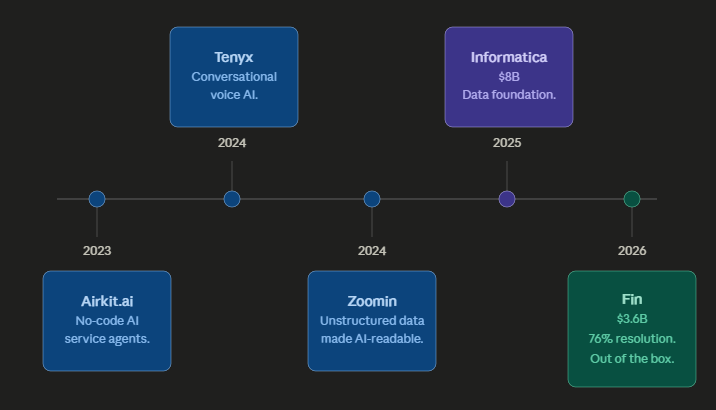
Here’s the proof. Each of the Salesforce acquisitions close a specific gap in the stack, fitting piece by piece into a larger vision: to give their customers every tool they need to push their customer service to the next level, and the one after that.
- Airkit.ai (2023) The opening move in the AI agent era. Airkit let businesses build no-code AI customer service agents and omnichannel engagement flows, without needing a team of engineers to do it. Salesforce absorbed it into Service Cloud. The DNA of Agentforce runs through this acquisition.
- Tenyx (2024) Tenyx built conversational voice agents that actually feel like conversations, not automated phone trees. Salesforce plugged it directly into Agentforce Service Agent, covering the one channel that still drives the most customer frustration, voice.
- Zoomin (2024) Zoomin makes unstructured data, product manuals, knowledge bases, internal guides, readable by AI agents in real time. Without this layer, agents guess. With it, they answer accurately. Salesforce bought the solution to the hallucination problem before it became a public liability.
- Informatica (2025, $8 billion) AI agents are only as good as the data they run on. Informatica brings enterprise-grade data integration and governance to the platform. This was Salesforce buying the foundation the entire customer service stack sits on. Clean data in, reliable AI out.
- Fin (2026, $3.6 billion) Fin, formerly Intercom, is the most mature AI customer service agent platform available today. Its proprietary model, Apex, was built specifically for customer support workloads. Not a general-purpose LLM repurposed for service. Today, Fin resolves an average of 76% of support requests without any human involvement, out of the box, no custom training required.
Fin’s acquisition also brings 30,000 customers who have already been running AI in their customer service operations. That's years of real-world data on what works, what breaks, and what customers actually respond to. Salesforce isn't just buying a product. They're buying the collective intelligence of tens of thousands of deployments. Every Salesforce customer inherits that knowledge.
And the acquisitions are already shipping as product, not just strategy:
- Agentforce Contact Center (2026) It's Salesforce building native voice and telephony directly into the CRM, so the CCaaS layer and the CRM layer become one product instead of two connected ones. It unifies voice, chat, email and CRM data in one system, so AI agents can get full customer history instead of a separate contact centre platform stitched in. Live in the US, soon for AU.
- Help Agent (2026) A prepackaged AI agent that answers questions and resolves cases across your website, portal and messaging channels, live in days rather than months. And it's priced so you only pay when it actually resolves the case.
Few platforms will survive the AI era. Salesforce is making sure they're one of them. The right infrastructure, the right innovation, and now the real-world knowledge of what actually works in customer service.
But aren’t companies going to vibe code their own customer service platform?
It comes up, especially with AI tools getting more accessible every month.
But building your own customer service AI platform means building the data infrastructure, the omnichannel routing, the voice AI, the unstructured data pipelines, the security framework, and the ongoing model training. Salesforce just spent over $11 billion and a decade doing that work.
The smarter play is focusing your team's energy on what only your business can build: the workflows, the service logic, the customer experiences that reflect your brand. Let the platform carry the infrastructure.
ProQuest on the customer service ground
We don't just believe in this platform. We've built on it, for real businesses, solving real problems.
Kogan.com, one of Australia's most loved online retailers serving over 4 million active customers, partnered with ProQuest to migrate from Zendesk to Salesforce Service Cloud and never looked back. Read the full story.
Zimmer Biomet, a global leader in musculoskeletal healthcare operating across 25+ countries, was processing 60,000 purchase orders a year. Manually. ProQuest built a fully connected AI-powered customer service operation that changed that completely. Read the full story.
We love this platform. Not because we sell it, but because we've seen what it does when it's implemented with a clear outcome in mind.
The clients who get the most from it aren't the ones chasing every new feature. They're the ones who start with a clear picture of their customer service outcomes and work backwards to the capabilities that close the gap. Outcome first, platform second. That's where the real value lives.
Salesforce has spent a decade building the foundations. The last three years acquiring the missing pieces. And the last twelve months shipping it all as a unified customer service platform.
The window to get ahead of this, before your competitors do, is open. Take advantage of this now with ProQuest.