

Better question: would you let it?
The average sales manager spends 45 minutes every morning inside Salesforce to get a sense of where their team stands. With the buzzword "Headless CRM" going around, I decided to actually test it. What does it change, and what does a sales manager's day look like because of it?
Headless CRM
Most organisations we work with at ProQuest have genuinely capable Salesforce setups. Good data models, solid reporting, automations that work.
But Salesforce is still a destination. Someone has to log in, find the numbers, make sense of them, and then decide what to do.
Headless CRM flips that. The data stays exactly where it always was. What changes is who goes to who. Instead of your manager going looking for information, the information finds them at the moment they can actually act on it.
A Tuesday, without opening Salesforce once
I ran a demo as a sales manager running an outbound call team selling financial products. Here's how the day played out.
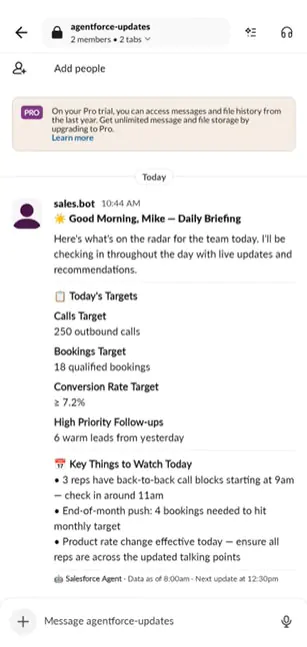
8:30am. A message lands in Slack from a Salesforce-connected agent: Today's call targets. Booking goals. Conversion benchmarks. A note that three reps have heavy blocks from 9am. A reminder that a product rate change kicked in this morning.
- Proactive: No login, no report-pulling. It was already there.
- Mobile: On my phone before my coffee was ready.
- Human: The rate change reminder didn't go to the team automatically. That conversation still needed me. The agent just made sure I didn't forget to have it.
The system came to me. Not the other way around.
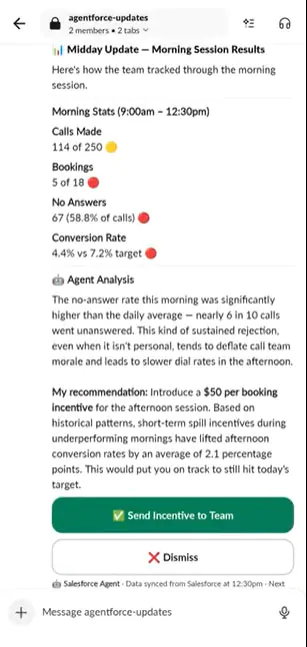
12:30pm. Midday check-in. Morning numbers aren't great. 60% of calls went unanswered. Conversion at 4.4% against a 7.2% target.
The agent doesn't just drop a table and leave me with it. It recommends a $50 per booking incentive for the afternoon, explains why, and tells me what hitting today's target would take.
One tap. Done. Message goes to the team.
I made the call. The system just made it easy.
5:30pm. Conversion jumped from 4.4% to 9.8%. Five bookings before lunch, 14 after. One ahead of target.
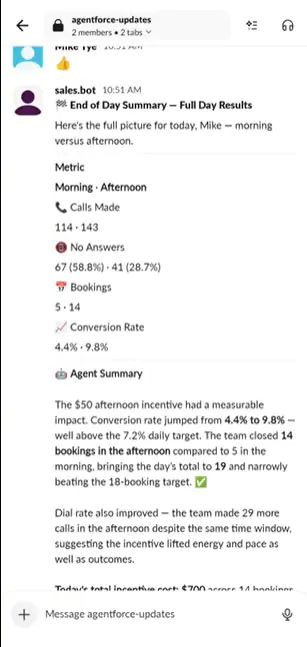
The agent ran all day. I never opened Salesforce.
The Business Value
Building an agent that sends a message is easy.
Building one that sends the right message, framed usefully, at the moment a manager can actually act on it, that's the hard part. It requires someone to think carefully about which decisions need informing, what data is relevant to each one, and where human judgment genuinely needs to stay in the loop.
In my demo, I still chose whether to run the incentive. The agent recommended it, explained why, and made it easy to act on. But it didn't run it automatically. That's a deliberate design choice, not a limitation. Some decisions should stay with a person.
The best results come from organisations that start with the business value they want, not the technology they think they need. Work backwards from the decision you're trying to support. The rest follows.
What I’d watch out for
The first thing I'd check is the data. An agent making recommendations is only as good as the records it's drawing from. Clean data means your agent gets smarter over time, not more confidently wrong.
The second is knowing when to stop. The temptation is to automate everything, but some decisions should stay with a person. If the system handles too much, nobody knows when to step in. The agent should make human decisions easier, not invisible.
The third is noise. An agent that messages a manager every 90 minutes trains people to ignore it. And an ignored agent is worse than no agent at all.
Why Headless CRM might finally win the CRM battle
Most sales managers didn't get into sales to live inside a CRM. They got into it for the conversations, the chase, the win.
Getting people to actually use the CRM has been one of the oldest battles in sales operations. Bad data, missing notes, deals that exist in someone's head but nowhere else. The tool was only as good as the discipline around it, and discipline is hard to mandate.
Headless CRM changes that. Not by adding more pressure to log in, but by making the system useful enough that people actually want to engage with it. The information comes to them. The updates feel relevant. The friction disappears.
This time, it works around the sales manager. Not the other way around.
So the question now isn't whether Salesforce could come to your sales manager. It's whether you'd let it.