

It’s not uncommon for repeat visits to happen simply because the wrong technician was sent, at the wrong time, for the wrong job.
After researching over 600,000 real technician records, Aquant found that average field service teams incur a 24% avoidable dispatch rate. Top-performing teams sit at just 3%.
When this happens repeatedly, even to experienced dispatchers and skilled technicians, the cause usually sits hidden in plain sight: how the scheduling logic was set up in the first place.
Over the past 10 years, we at ProQuest have delivered countless Field Service implementations, and found out that they almost always start the same way: technicians sent to the wrong locations, too much time lost on the road, fuel budgets blown out, and customers left waiting.
What we’ve found is that the real problem usually sits in the scheduling logic. It either lives in the heads of experienced dispatchers, or in a system configured to optimise for the wrong things. Either way, the result is the same: the business doesn’t have a systematic way to produce the best possible field service schedule.
The Logic Behind Every Field Service Scheduling Decision
Strip away the branding, and most scheduling systems we've worked with make assignment decisions in two stages.
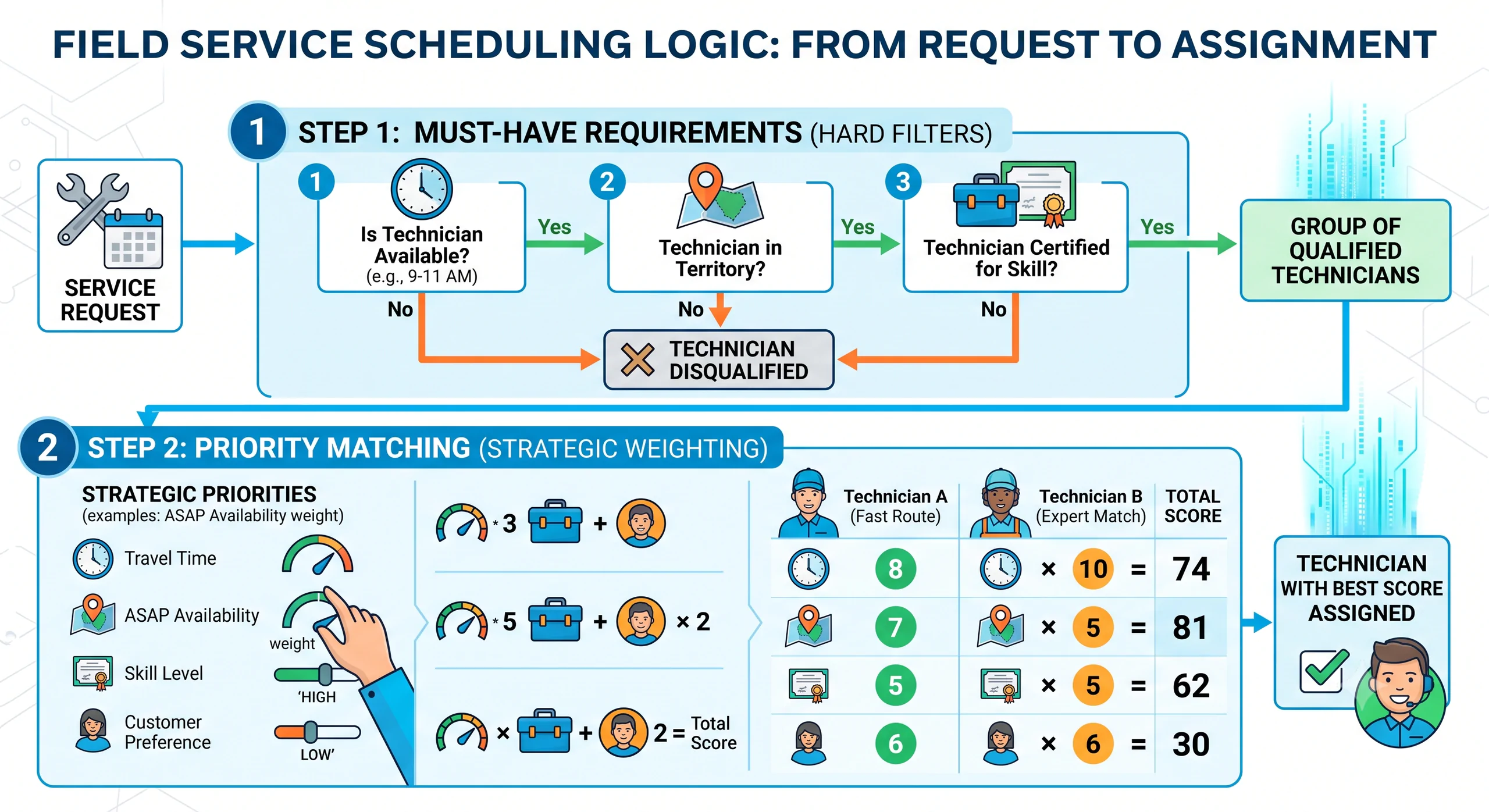
Stage 1 is a hard filter. The system asks yes-or-no questions: is the technician available, are they in territory, do they have the right skill or certification. Fail one, and you're out of the running. No exceptions, no scoring.
Stage 2 is a priority ranking. Once you've got a shortlist of qualified technicians, something has to decide who actually gets the job. That's where weighted priorities come in, things like travel distance, earliest arrival, or customer preference, each scored and totalled to find the best fit.
In Salesforce, this shows up as Work Rules (stage 1) and Service Objectives (stage 2). The label changes from platform to platform, but the underlying pattern, filter first, then rank, shows up again and again.
The Trade-Off Nobody Configures For
Most platforms let you fine-tune a dozen different priorities. But almost all operational friction comes down to 3 things fighting for the same calendar slot:
- Speed. Prioritise the soonest available slot, and technicians end up criss-crossing town more than they should.
- Efficient routing. Prioritise drive time, and you cut fuel and overtime, but customers wait longer for the closest available tech.
- Right match. Weight skill matching heavily, and jobs go to your best people, every time, until your best people burn out while less experienced staff sit underused.
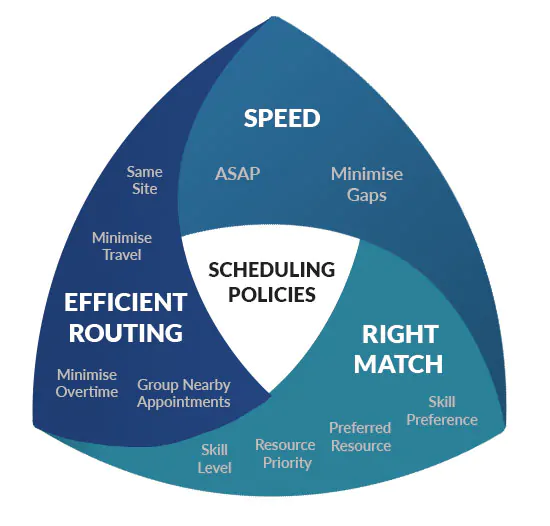
You cannot max out all 3 at once. That's not a limitation of the software. That's the trade-off. Every scheduling decision you make is really a decision about which of these 3 you're willing to sacrifice, and by how much.
4 Ways Field Service Scheduling Setups Quietly Break
| Mistake | What actually happens |
| 1. Setting every priority to maximum | Nothing is actually prioritised. The system falls back on arbitrary tie-breaks. |
| 2. Overriding exceptions without tracking the pattern | One-off overrides are normal. Recurring ones mean your policy no longer matches how the business actually runs. |
| 3. Treating the setup as one-and-done | Territories expand, job types shift, and old weightings quietly stop working. |
| 4. Fixing the weighting without fixing the filters | If the underlying rules are wrong, no amount of priority tweaking saves the schedule. |
How to Actually Find the Balance
Adjusting scheduling priorities is a business decision dressed up as an IT task. IT can configure the settings. Only the business knows which trade-off it can afford.
Test before you trust it. Before pushing new priorities live, run them against test data first. Look at what actually gets assigned before you let it touch real customers.
Watch the right numbers. Not "is the calendar full," but:
- First-Time Fix Rate (FTFR): Low FTFR often indicates skill matching is under-weighted.
- Average Travel Time: Spike in drive time means ASAP/Speed is overly dominant.
- Employee Satisfaction: Burnout signals over-reliance on preferred/senior technicians.
- Customer Satisfaction (CSAT): Drops point to missed appointment windows or delayed dispatches.
What Getting This Right Actually Changes
For the business, it's the clearest line back to money: fewer wasted truck rolls, lower fuel spend, more billable jobs per day.
For dispatchers, it's less firefighting and more confidence that the automated call is the right one.
For technicians, it's a workday that makes sense. Logical routing, fewer double bookings, and a fairer share of the hard jobs.
AI is starting to change how this gets managed too. Tools like Salesforce Agentforce let schedulers ask a console to summarise a territory or flag a conflict in plain language. But that only works if the underlying rules and weightings are sound to begin with. AI makes a good setup faster. It doesn't fix a bad one.
The schedule isn't broken because your team is bad at their jobs. It's broken because nobody decided which trade-off they're willing to live with.
If you're not sure which trade-off your current setup is actually making, that's usually a quick thing to check. Happy to have a look.