People have relied on Salesforce as the one source of truth, the one place your teams live. Businesses bought in, built on top of it, and structured entire operations around it.
But with the rise of Headless CRM, is Salesforce being pushed off centre stage? Will it lose its crown, or simply move to a more powerful seat?
Things are changing. Here's what it actually means for your business.
What Headless CRM actually is
Every time your team opens Salesforce, they're interacting with data through a screen interface. That's the head. It translates important data to workable information, everything your teams rely on to get through the day. Dashboards, reports, customer and engagement history.
Now take that head off.
The data and logic doesn't go anywhere. But it's no longer locked inside one interface. Your teams can access it across different systems, different experiences, different touchpoints. You're no longer limited to building within what Salesforce's UI can do out of the box.
What it means for Salesforce specifically
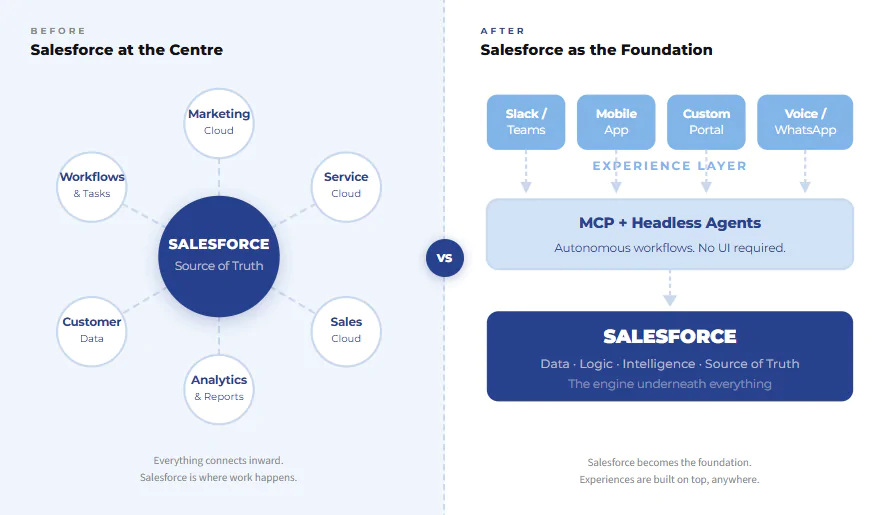
Salesforce has spent years positioning itself as the centre of your customer data universe. The one place your business runs from. But when its UI is removed from the equation, the double edge emerges.
The same openness that makes Salesforce more powerful in a headless world also makes it easier to route around it. More flexibility means more choice. And more choice means Salesforce has to keep earning its place in your stack or risk being sidelined.
But here's the thing. They know it. In fact, they're building for it. Salesforce is reshaping itself around where work is actually happening, and that's exactly how it stays essential.
Salesforce recently launched Headless 360, which lets your teams get work done without ever opening Salesforce. Workflows now surface directly inside Slack, Microsoft Teams, WhatsApp, and voice interfaces. The conversation becomes the interface. The CRM becomes the engine running quietly behind it.
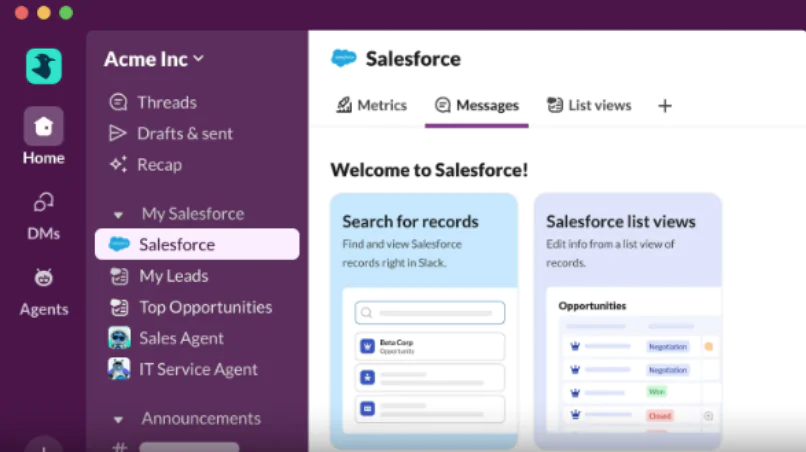
Salesforce data, right inside Slack.
And it goes further. Headless agents, powered by Salesforce's Agent API, can now run autonomously in the background without any human trigger from a UI. An automated process can call an agent directly, handle complex workflows, and get things done, all without anyone logging into a dashboard.
What it means for your business
Headless is a shift in how your entire organisation relates to customer data. Before you get excited, a few honest questions worth sitting with:
- Is your data actually clean? Headless architecture amplifies what's already in your CRM. If your data is messy now, it'll be messier at scale.
- Are your teams ready to work differently? Marketing, IT, and product teams suddenly have different relationships with the same data. Navigating that means understanding how your people use data to do their best work, and finding the fastest way to get them there.
- Who's making the decisions? When the CRM is no longer the centre, the decisions about what to build, where, and how become significantly more complex. You need clarity on ownership before you start.
Want to see it in action? Here is how sales managers can use Headless CRM in Slack.
So where does that leave you?
Every business will eventually move to headless. Salesforce is already reshaping itself for this future. The question is whether your business moves with intention or gets left playing catch-up. You don't have to navigate it alone. This is exactly the kind of shift where the right partner makes the difference between a smooth transition and an expensive lesson. That's where ProQuest comes in.