
If you have just seen a Salesforce demo, you are probably excited. And you should be. What you saw was a glimpse of what is genuinely possible: intelligent workflows, real-time visibility, seamless customer experiences. Salesforce is the most powerful CRM platform ever built, and the demo only scratches the surface.
But there is a gap between what you saw and what it takes to make that a reality for your business. Understanding the gap is not a reason to hesitate. It is the reason to get the right team behind you from the start.
The Ferrari Problem
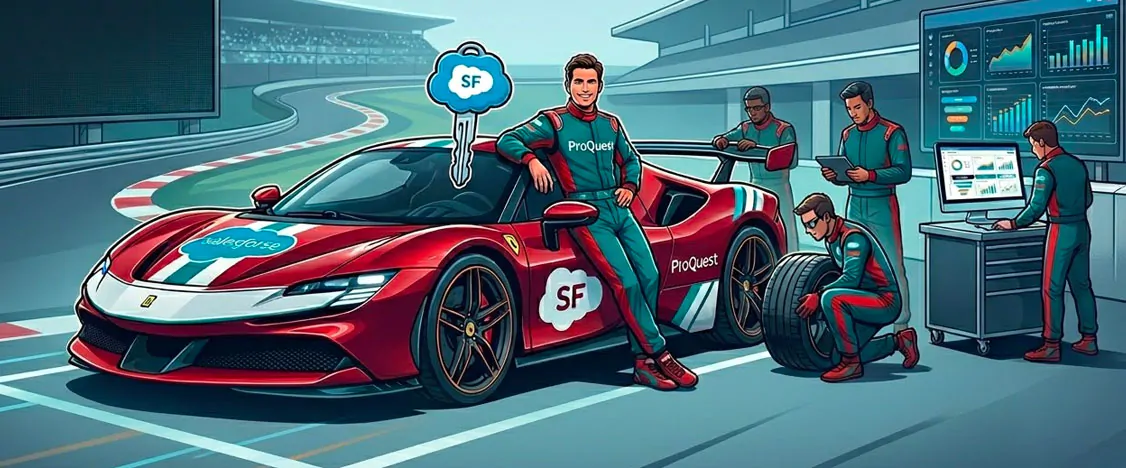
Think of it like a Ferrari. Handing someone the keys to one of the most powerful machines ever engineered does not automatically make them a racing driver. The car has extraordinary capability. But without the right setup, the right team, and a driver trained to extract everything the car has to give, that capability goes unrealised. The Ferrari does not become less of a Ferrari. It just never gets to show you what it can do.
Salesforce is the Ferrari. What you receive on day one is a powerful, high-performance platform awaiting configuration: standard objects, generic reports, and integration capability ready to be shaped. The engine is exceptional, but implementation determines whether you win races or simply own an expensive car.
The demo showed you what the car looks like at full speed. Implementation is the work that happens before the first race: understanding your track, building the right setup, and making sure everything is configured to perform under your specific conditions. A skilled team can build something impressive in a matter of days for a demo because they already know the answer before they start. However, bringing that to life into your implementation is different. It has to be built around your business, your processes, and your people.
1. Choosing the Right Implementation Partner
After seeing the demo, it is natural to think: if a team built that in a few days, imagine what they could build with more time. And that instinct is right, but it comes with an important caveat.
The demo was built with a generic business in mind. Your implementation needs to be built around yours. That requires a partner who invests deeply in understanding your business before writing a single line of configuration.
If Salesforce is the Ferrari, your implementation partner is the race engineer. Their job is not just to configure the car. It is to manage vehicle setup, data analysis, strategy, and radio communication to optimise performance during every single race weekend.
A strong implementation partner does not begin by configuring. They begin by confronting the questions that determine whether your implementation will hold up under real conditions:
- What is your vision behind your Salesforce implementation?
- What does success look like?
- How are we going to measure success?
- What are the biggest risks on this project?
These questions are not technical. They are operational. Most underperforming Salesforce projects were not technical failures. They were the result of ambiguous processes being automated before anyone had resolved them.
The right partner resolves the ambiguity before automation begins. They are not delivering software. They are reducing long-term risk.
2. The Client’s Role in Making Salesforce Work
Even the best race engineer cannot build a winning car without the driver. Implementation is a partnership, and the depth of your organisation’s engagement directly determines the quality of the outcome.
When leadership invests time early, requirements get validated, decisions get made, and trade-offs get resolved before they become expensive problems. When leadership disengages, requirements drift, the configuration drifts with them, and what gets built no longer reflects the strategy it was meant to support.
Getting everything right on the first deployment is almost impossible, and expecting that puts enormous pressure on an already complex process. The organisations that get the most from Salesforce are not the ones that launched perfectly. They are the ones who launched well and are committed to continuous improvement.
Your business will change. Your teams will grow. Your strategy will evolve. Salesforce needs to evolve with it. The implementation is the starting grid, not the finish line.
3. Adoption Is the Real Measure of Success
In Formula 1, no team arrives at the first race with a perfect car. They arrive with the best car they could build given what they know. Then they learn. Every race weekend generates data. The engineers study it, identify what to improve, and bring updates to the next track.
Every track is different. Every season, the driver grows. What worked in Melbourne may need rethinking by Monaco. The teams that win championships are not the ones with the fastest car at round one. They are the ones who improve the fastest over the course of the season.
Salesforce works the same way. After go-live, your teams will start using the system in ways that reveal new friction points, new opportunities, and new requirements that simply could not have been anticipated during design. That is not failure. That is the process working as it should.
Adoption cannot be mandated. It is earned through relevance, clarity and reinforcement. Workflows must reflect how people actually work. Reporting must answer the questions leaders actually ask. And executive sponsorship must remain visible long after launch, not just at go-live.
Salesforce is powerful. Implementation makes it aligned. Continuous improvement makes it invaluable.
The Opportunity in Front of You
What you saw in the demo is real. That capability exists. Getting there for your business takes the right partner, genuine leadership commitment, and a mindset of continuous improvement rather than one-time delivery.
The organisations that extract measurable return from Salesforce are not necessarily the ones with the biggest budgets. They are the ones that define how they intend to operate, commit leadership time early, confront ambiguity before automation, and design for adoption from the outset. They set a strong foundation, stay engaged, and keep tuning the car.
Salesforce will scale with your organisation. The question is whether your implementation discipline will scale with your ambition.
If you are ready to explore what Salesforce could look like for your business, or simply want to talk through what a strong implementation looks like, we would love to be part of that conversation.