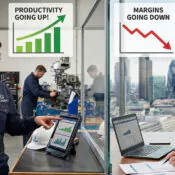

Most organisations already have Artificial Intelligence in their business. What many executives still struggle to explain is what it is actually improving.
The last few years were about exploring Artificial Intelligence: Pilots. Proofs of concept. AI labs. Demos that impressed but rarely made it into everyday work. 2026 is the year that this changes.
Artificial Intelligence is already increasing productivity, influencing decisions, shaping outcomes, and setting expectations across the business. The conversation is no longer about what AI can do. It is about what it is expected to deliver.
The executives who win in 2026 will be precise. Precise about where it adds value, what it is responsible for, and how its impact is measured. They will stop funding Artificial Intelligence for its promise and start judging it on results.
That is what executives should really be demanding from AI now.
- Demand that it Solves a Real Problem First
Artificial Intelligence does not need to transform the entire business on day one. That expectation usually wastes time and budget.
What it needs is a clearly defined problem, owned by the business.
In organisations getting value from AI, new initiatives are approved because:
- a specific decision is underperforming
- a known process is creating friction
- a measurable outcome is being missed
AI is then treated like any other investment. It is judged on whether that outcome improves or not.
If it does, the business scales it with confidence.
If it doesn’t, the learning informs the next initiative.
Either way, progress is made. This is how AI moves from experimentation into a repeatable business capability, without betting the organisation on ambition alone.
- Demand AI That Sharpens Decisions Without Taking Authority
Its real value is not in making decisions instead of people. It is in making people better decision-makers.
Executives should expect Artificail Intelligence to sharpen judgment by:
- surfacing the right information at the right moment
- highlighting trade-offs that are easy to miss
- learning from outcomes and corrections over time
As it absorbs more data and feedback, its recommendations become more aligned with how the business actually operates. Not in theory, but in practice. It starts to reflect organisational judgement, not replace it.
Authority, however, stays with people. That matters.
When it supports judgment rather than owning it, accountability remains clear, trust builds naturally, and adoption follows. Decisions improve because they are better informed, not because responsibility has been handed off.
This is where we consistently see the difference between AI that accelerates performance and AI that quietly stalls.
- Demand AI That Is Embedded in How Work Actually Gets Done
If people have to go looking for AI, it has already lost. Artificial Intelligence that lives outside current work processes does not change behaviour. It gets ignored.
Artificial Intelligence earns trust when it is embedded directly into how work is already done. Inside the process. Inside the workflow. Inside the systems people rely on every day.
When it becomes part of the process, a few important things happen:
- it feels less like a tool and more like support
- people use it without thinking about it
Over time, repetition builds confidence, and confidence turns into reliance.
That reliance is what unlocks real adoption.

This is a pattern we consistently see once it is embedded into live Salesforce environments. Agentforce works because it sits inside core business processes teams already use every day. Because it lives where the work happens, Artificial Intelligence does not need to be explained, promoted, or pushed. It is simply there, supporting decisions as part of the flow.
That is when AI becomes normal. And normal is where it can scale faster, and smoother.
- Demand AI That Can Prove Its Worth
Artificial Intelligence gets credit for changing outcomes. Executives should be able to point to exactly where it is making a difference. Not in theory. Not in future state. In day-to-day decisions and results.
A simple test applies:
- Which decisions are better because Artificial Intelligence is involved?
- Which outcomes improve as a result?
- What becomes harder if it is switched off?
If those answers are unclear, Artificial Intelligence is still operating on goodwill rather than value.

Artificial Intelligence earns its place by proving, repeatedly, that it helps the business make better decisions, faster and more consistently.
This 2026, Artificial Intelligence is ready to scale. The difference will be made by leaders who are clear about what AI is responsible for, and ruthless about whether it delivers.